Page builders feel like the smart choice. Drag something in, see it appear, ship your store in a weekend. Pagefly, Gempages, Shogun — they all promise a professional looking store without writing a single line of code. The problem is what happens six months later, when your store is loading slowly, your Google rankings are not moving, and your conversion rate is stuck. The page builder is usually a big part of the answer.
What Is a Page Builder and Why Do People Use Them
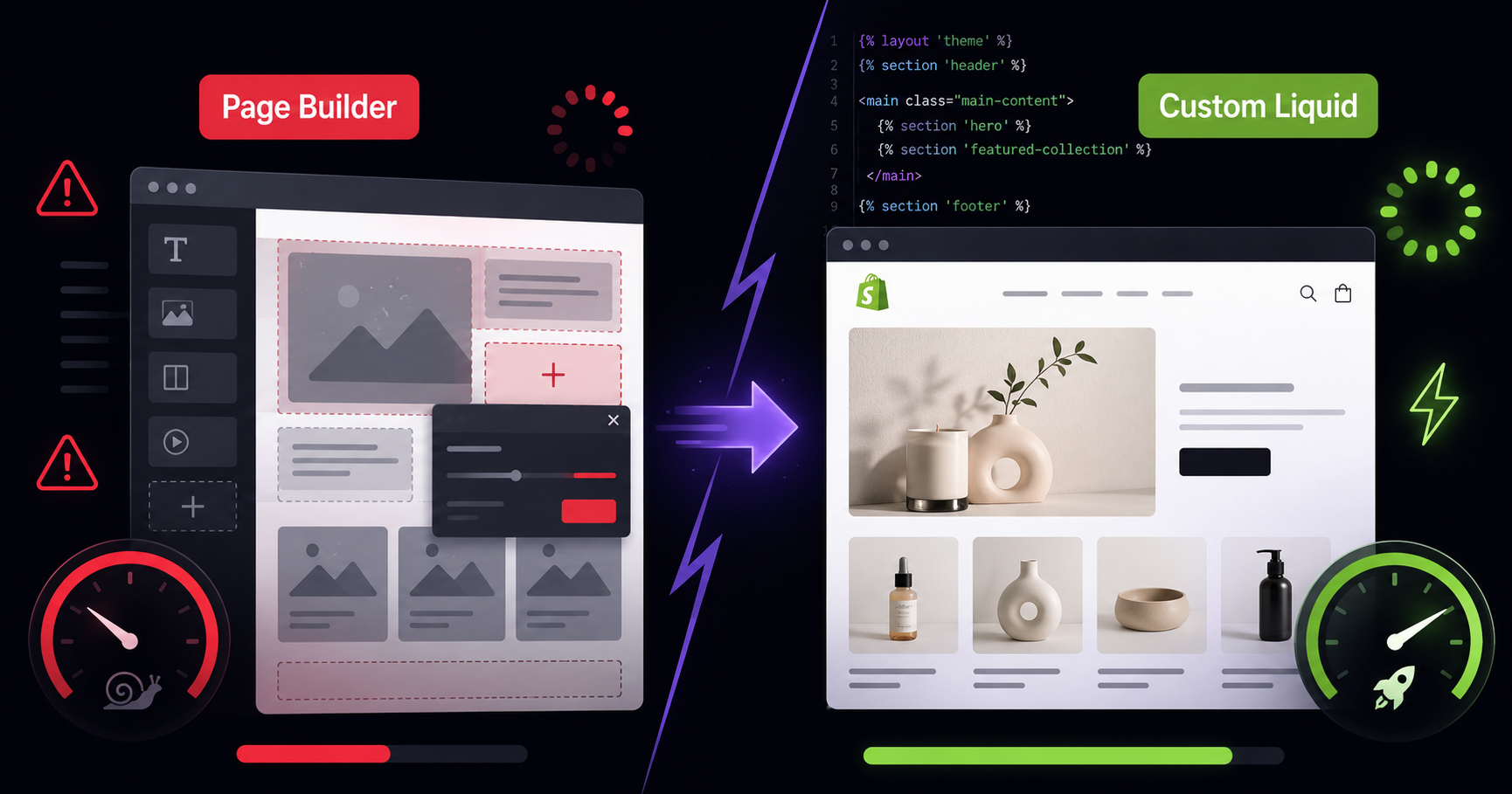
A page builder is a third-party Shopify app that lets you design pages visually — dragging elements like text blocks, image rows, countdown timers, and product grids onto a canvas without code. Popular ones include Pagefly, Gempages, Shogun, and Zipify.
They are popular because they lower the barrier to getting a store online. You do not need to know Liquid, you do not need a developer, and you can see changes instantly. That accessibility is real and valuable — but it comes with tradeoffs that only show up once your store starts getting real traffic.

The appeal is real: Page builders let non-developers launch faster. The issue is not the tool itself — it is using it as a long-term foundation for a store you want to grow seriously.
The Hidden Cost Nobody Talks About
Every page builder app charges a monthly subscription — usually between $19 and $99 per month. That is $228 to $1,188 per year, every year, just to maintain pages you have already built.
Cancel the subscription and your pages either break or revert to a blank template. You do not own what you built. You are renting it. A custom Liquid theme is a one-time cost. Once it is built, it is yours permanently — no subscription, no dependency, no risk of losing your pages if an app shuts down or raises its prices.
Page builder per year (ongoing)
Custom Liquid — one-time, you own it
Ownership with a page builder
Page Builders and the Speed Problem
Page builder apps work by injecting their own JavaScript, CSS, and HTML on top of your theme. Every element you drag in adds more code — code that was not written for your store and is not optimised for performance. The result is a page bloated with render-blocking scripts, unused CSS, and extra HTTP requests.
Google PageSpeed scores in the 30s and 40s are common for stores built heavily on page builders. Google uses page speed as a ranking signal. Slow pages rank lower. And slow pages lose visitors.

Real numbers: A store loading in 1 second converts up to 3x better than one loading in 5 seconds. Page builders routinely add 2 to 4 seconds of unnecessary load time through bloated scripts alone.
How Page Builders Hurt Your SEO
Search engines read your page's HTML to understand what it contains. Page builders generate HTML that is often messy, deeply nested, and semantically incorrect — meaning headings in the wrong order, missing alt tags, duplicate content, and JavaScript-rendered text that crawlers may not index properly.
Clean, handwritten Liquid generates clean, semantic HTML. Every heading is in the right place. Every image has proper alt text. The page structure makes sense to both humans and search engine bots. If you are spending money on SEO or waiting for organic traffic to grow, a page builder is working against you at the code level — even if the page looks fine visually.
SEO reality: Clean Liquid code produces semantic HTML that search engines can read, crawl, and rank correctly — giving your store a stronger organic foundation from day one.
Why Generic Design Kills Conversions
Every page builder uses the same drag-and-drop blocks. Every store built with Pagefly or Gempages draws from the same library of elements and the same layout patterns. Your store ends up looking like every other page builder store — and visitors can feel it, even if they cannot articulate why.
Trust is visual. A store that looks custom, intentional, and built specifically for its products communicates quality before a visitor reads a single word. A store that looks like a template raises doubts about whether the product is worth investing in.
What a Custom Liquid Theme Does Differently
A custom Liquid theme is built from scratch — specifically for your store. Every section, every template, every snippet is written to do exactly what your store needs and nothing more.
- Code is lean — pages load fast with no bloat
- Design is pixel-perfect to your brand
- Every section is editable from the Shopify admin — no developer needed for content changes
- Theme is yours permanently — no subscriptions, no app dependency
- Clean semantic HTML built for SEO from the ground up
- Performance optimised from day one — not as an afterthought
What you get with custom Liquid: Fast load times, clean SEO-ready HTML, unique design that matches your brand exactly, full admin control, and permanent ownership — no recurring app fees.
Who Actually Needs a Custom Liquid Theme
Not every store needs to go fully custom from day one. Here is an honest breakdown:
You need a custom Liquid theme if:
- You have a specific design in mind and want it built exactly as envisioned
- Your store is getting real traffic and your PageSpeed score is below 60
- You are investing in SEO and want clean, semantic code as the foundation
- You are selling premium or high-ticket products where trust and design matter
- You want to own your theme permanently without ongoing app subscriptions
- Your current store looks like every other store in your niche
A page builder may be fine if:
- You are testing a product idea and just need something live quickly
- Your store is pre-revenue and you are not yet investing in SEO or paid traffic
- Speed and differentiation are not priorities at this stage
The Cost Reality
Custom Liquid development costs more upfront than setting up a page builder. A complete custom Shopify theme typically starts from $300 for smaller stores and goes up depending on complexity.
Compare that to a page builder at $50 per month. After 6 months you have spent $300 and you still do not own anything. After a year, $600. After two years, $1,200 — and your store is still dependent on the app staying available and affordable.
90+ PageSpeed score
Pixel-perfect custom design
Yours forever — no monthly fee
Red Flags Your Store Needs to Switch
- PageSpeed score below 50 on mobile
- Paying $50+ per month just to keep pages working
- Your store looks identical to competitors in the same niche
- Google rankings are flat despite consistent SEO effort
- Bounce rate is high and visitors leave within seconds
- You cannot make design changes without the page builder app
- Checkout experience feels disconnected from the rest of the store
Most stores outgrow their page builder setup. The question is whether you migrate before or after it becomes a serious problem for your growth.
Frequently Asked Questions
Are page builders like Pagefly bad for Shopify stores?
They are not inherently bad, but they add unnecessary code bloat, slow your store down, and create a monthly dependency. For stores serious about performance, SEO, and long-term growth, a custom Liquid theme is a significantly better foundation.
How much does a custom Shopify Liquid theme cost?
It depends on the scope. A clean custom theme typically starts from $300 to $500 for smaller stores. A full-featured theme with multiple custom sections and unique interactions will be higher. The cost is a one-time investment with no ongoing fees.
Can I migrate from a page builder to a custom Liquid theme?
Yes. Your products, collections, and customer data stay in Shopify — they are not tied to the page builder. What needs to be rebuilt is the design and layout of your pages. Most stores migrate without any data loss.
Will a custom Liquid theme improve my Google rankings?
Faster load times and cleaner HTML are both ranking signals Google uses. Switching from a bloated page builder to a lean custom theme typically improves PageSpeed scores significantly, which contributes positively to SEO over time.
Can I edit a custom Liquid theme myself without a developer?
Yes. A well-built custom Liquid theme uses Shopify's Sections Everywhere architecture, meaning all content — text, images, colors, layout — is editable from the theme editor without touching any code.
Thinking about switching from a page builder to a custom Liquid theme? Tell me about your store and I will give you an honest assessment of what it would take and what it would cost.