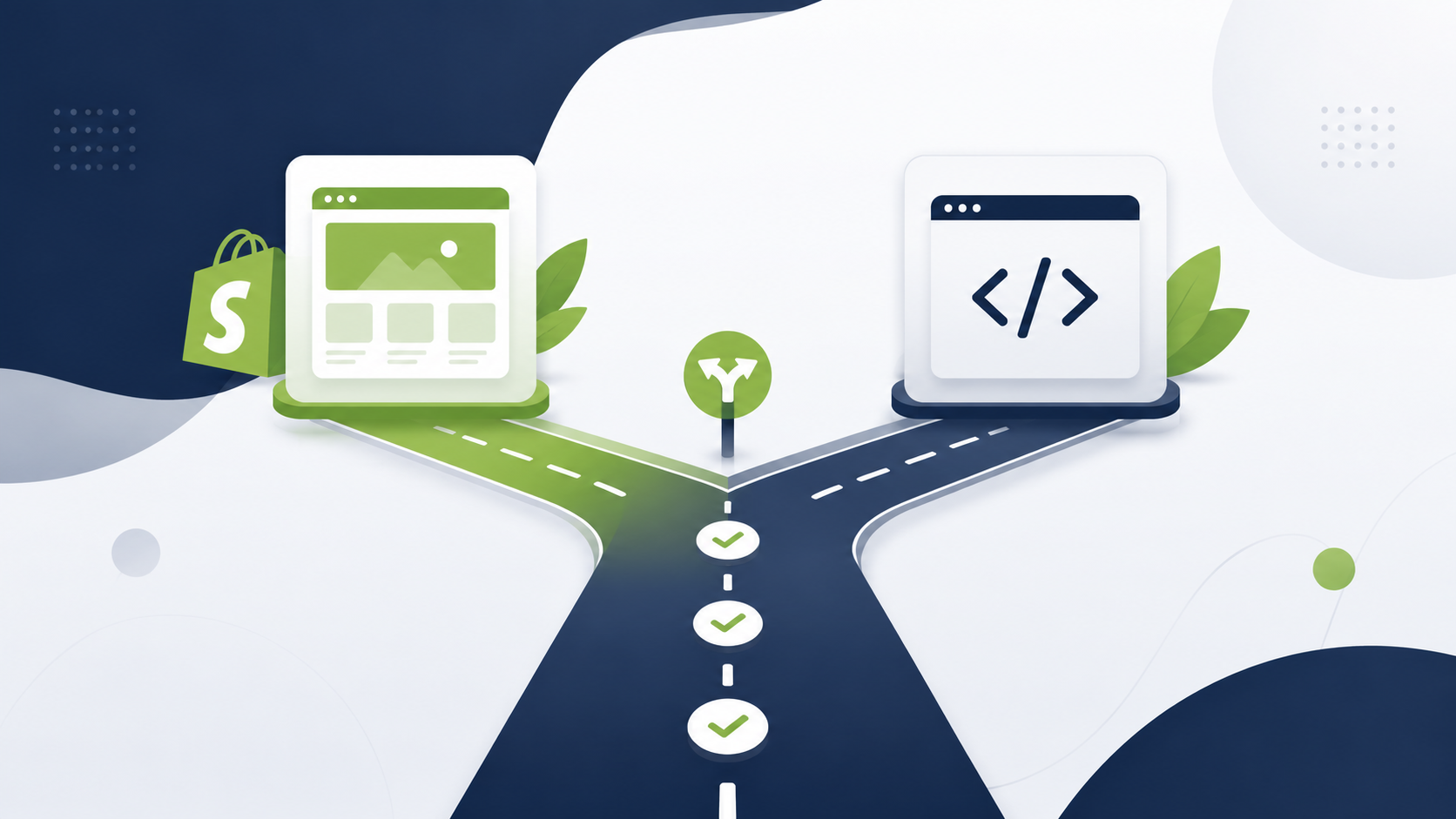
Most store owners try to answer this question with a gut feeling, and gut feelings are a bad way to spend a few thousand dollars. A better approach is running your specific situation through a short set of questions that actually predict which choice will work out. Here is that framework.
Why a Framework Helps More Than a Gut Call
A paid theme and custom development are not competing on quality alone, they solve different problems at different stages of a business. A framework forces you to look at your actual stage, budget, and goals instead of comparing screenshots and picking whichever one looks nicer today.

One line test: If you are still proving your product sells, choose the theme. If you are proving your brand is worth remembering, choose custom.
Step 1: Know Your Business Stage
A brand new store with no sales history should almost always start on a paid theme. You do not yet know which pages, products, or messaging actually convert, so spending heavily on custom design before that data exists is a guess dressed up as an investment.
An established store with consistent sales and real customer feedback is in a very different position. At this stage, custom development can be pointed directly at the specific pages and problems already costing you conversions.
Step 2: Weigh How Much Brand Matters
Some products sell mainly on price, convenience, or utility, where a clean template does the job fine. Other products depend heavily on how premium, trustworthy, or distinctive the brand feels, where a shared template layout can quietly undersell the product itself.
Ask yourself honestly whether your customers are choosing you partly because of how your brand feels, or purely because of what you sell and for how much.
Step 3: Be Honest About Budget
A paid theme typically costs 200 to 400 dollars, while custom development usually starts around 3,000 dollars. If your available budget needs to cover inventory, ads, and operations as well as the store itself, a theme frees up cash for the parts of the business that generate revenue directly.
Step 4: Check Your Timeline
A paid theme can be live within a few days. A full custom build typically takes two to four weeks depending on scope. If you have a launch date tied to inventory arrival, a seasonal window, or a marketing push already scheduled, factor that timeline into the decision as heavily as cost.
Step 5: Consider Where You Are Headed
If you plan to scale significantly, raise investment, or build a brand that competitors will study, a custom foundation tends to age better than a theme that thousands of other stores also use. If your goals are more modest or still uncertain, staying flexible on a theme keeps your options open without locking in a large upfront cost.

Common mistake: Choosing custom development because it sounds more serious, without any evidence yet that the product or brand needs it.
Putting the Framework Together
Run through the five questions above honestly. If most of your answers point toward early stage, price sensitive, and time constrained, a paid theme is the right call for now. If most of your answers point toward brand driven, established, and growth focused, custom development is worth the investment.
A mixed set of answers usually points toward a middle path, custom design for your highest impact pages while the rest of the store stays on a paid theme.
Cost Comparison
Paid theme, self styled and configured
Custom homepage or product page on top of a theme
Full custom development, built around your brand
Frequently Asked Questions
Choose a paid theme if your product and brand can succeed with a proven, general layout, your budget is limited, or you need to launch quickly. Choose custom development if your brand identity drives sales, you need functionality no theme offers, or you already have traffic being held back by your current design.
No, it usually pays for itself. A paid theme lets you launch, test your offer, and start generating revenue that can later fund a custom build once you know your product sells and what your brand actually needs.
Spending thousands of dollars on a custom store before validating that your product sells. If the offer does not work, that investment is wasted, whereas a paid theme keeps early risk low while you figure that out.
Losing sales to a generic looking store once your brand needs more than a theme can offer. Competitors with custom stores can start to look more established, which quietly affects trust and conversion over time.
Yes, and this is common. A developer can build custom sections on top of a paid theme rather than starting from nothing, which often costs less than a full custom theme while still solving the specific problems the theme alone could not.
Final Word
Paid themes and custom development are not rival philosophies, they are tools built for different stages of the same journey. A theme proves your product can sell. Custom development is what you reach for once your brand has earned the investment. The framework above will tell you honestly which stage you are actually in, rather than which one sounds more impressive to say out loud.